Generative UI Health Insurance Experience
Company: Elevance Health // Role: Senior Product Experience Designer
In early 2023, as generative AI began entering the mainstream, a small team of two Senior Product Experience Designers and an Experience Strategy Director explored what this emerging technology could mean for the healthcare experience. The result was a GenUI concept that reimagined how members could access personalized information, navigate complex healthcare decisions, and discover relevant next steps through a more conversational, adaptive experience.
With strong data foundations in place, there’s an opportunity to lead in AI-driven consumer engagement as competitors ramp up similar efforts. This initiative explores Generative UI to demonstrate how AI can synthesize relevant information, reduce member effort, and personalize the experience. The goal is to proactively support care journeys, improve digital containment, and enhance engagement through predictive, intent-aware interactions.
I worked on this experience from early-stage concept development through delivery. Throughout the process, I partnered with the user research team to refine the experience, and I worked with development to refine and adapt designs for technical feasibility while preserving the core vision. The experience continues to evolve as new opportunities for improvement emerge.
Experience Strategy
Overview
As AI transforms digital experiences, the business identified an opportunity to lead in the health insurance space by leveraging its investments in data quality to drive a Generative UI (GenUI) experience. This case study outlines the strategy, research, and phased rollout of GenUI – designed to simplify healthcare navigation, reduce member effort, and increase digital engagement.
Problem
Members often struggle to find relevant information about their benefits, care, and health coverage. Existing tools require users to know exactly what to look for and where to find it, creating a high cognitive load. Meanwhile, competitors are rapidly advancing their AI capabilities, making speed to innovation essential.
Objective
Develop and test the foundational components of a GenUI experience to:
Reduce member effort by synthesizing and surfacing relevant information.
Personalize support across coverage, care, and wellness needs.
Proactively guide members through their healthcare journey.
Increase digital containment and engagement.
GenUI was expected to:
Answer questions about insurance, care, and conditions.
Recommend relevant tools already available in the current app.
Surface contextual content and education.
Guide members based on predictive insights.
User Research
Method
Participants reviewed clickable prototypes (desktop and mobile) and completed tasks during 1:1 interviews to evaluate usability and value.
Key Findings
Positive reception: Participants appreciated the simplified, personalized approach compared to traditional insurance platforms.
Cognitive relief: GenUI’s proactive suggestions helped reduce user mental load.
Pain points: Confusion occurred when users didn’t know how to phrase queries or received irrelevant results.
Visibility matters: Featuring GenUI on the home screen made it feel accessible and trustworthy.
Recommendations
Expand GenUI’s personalization by leveraging prior interactions and plan-specific data.
Implement guided prompts to help users understand how to interact with GenUI.
Integrate GenUI into the landing page for a seamless experience.
Ensure consistent, accurate responses and robust fallback paths.
Content Strategy
GenUI content follows the business’s brand voice – Experienced Ally – to build trust and provide human, empathetic, and proactive support.
Content Guidelines
Clear, concise, and accessible (508-compliant)
Personalized and predictive
Active voice with a contextual tone
Empathetic and aligned to user goals
Intent- and behavior-driven content delivery
Key Attributes: Clarity | Simplicity | Personalization | Proactivity | Predictive Guidance
Rollout & Pilots
Pilot 1
Small internal audience: ~150 users
GenUI accessible from home screen (app + web)
Introduced foundational UI elements (loaders, system errors)
Core content: Benefits, Care, Claims, General Info
Pilot 2
Large internal audience: ~75k users
GenUI becomes default home screen
New features: follow-up prompts, plan progress, prior auth, referrals
Included “unhappy path” scenarios for error handling
Pilot 3
Entire internal audience: 100k+ users
Enhanced features (e.g., live agent chat)
Impact & Evolution
This work helped establish a foundation for future virtual assistant experiences, informing subsequent explorations of personalized guidance, contextual support, and conversational interactions.
Concept
This GenUI concept explores a more personalized, proactive virtual assistant experience and serves as the foundation for the current virtual assistant across the health insurance website and app. It brings together the information and resources most relevant to a member’s needs. For example, a member considering knee replacement surgery could receive tailored benefit details, deductible and out-of-pocket progress, a list of in-network knee surgeons, and helpful resources such as questions to ask their surgeon. Contextual follow-up prompts guide members toward related information and next steps, creating a more connected experience that helps them navigate complex healthcare decisions with greater confidence.
Experience Flow
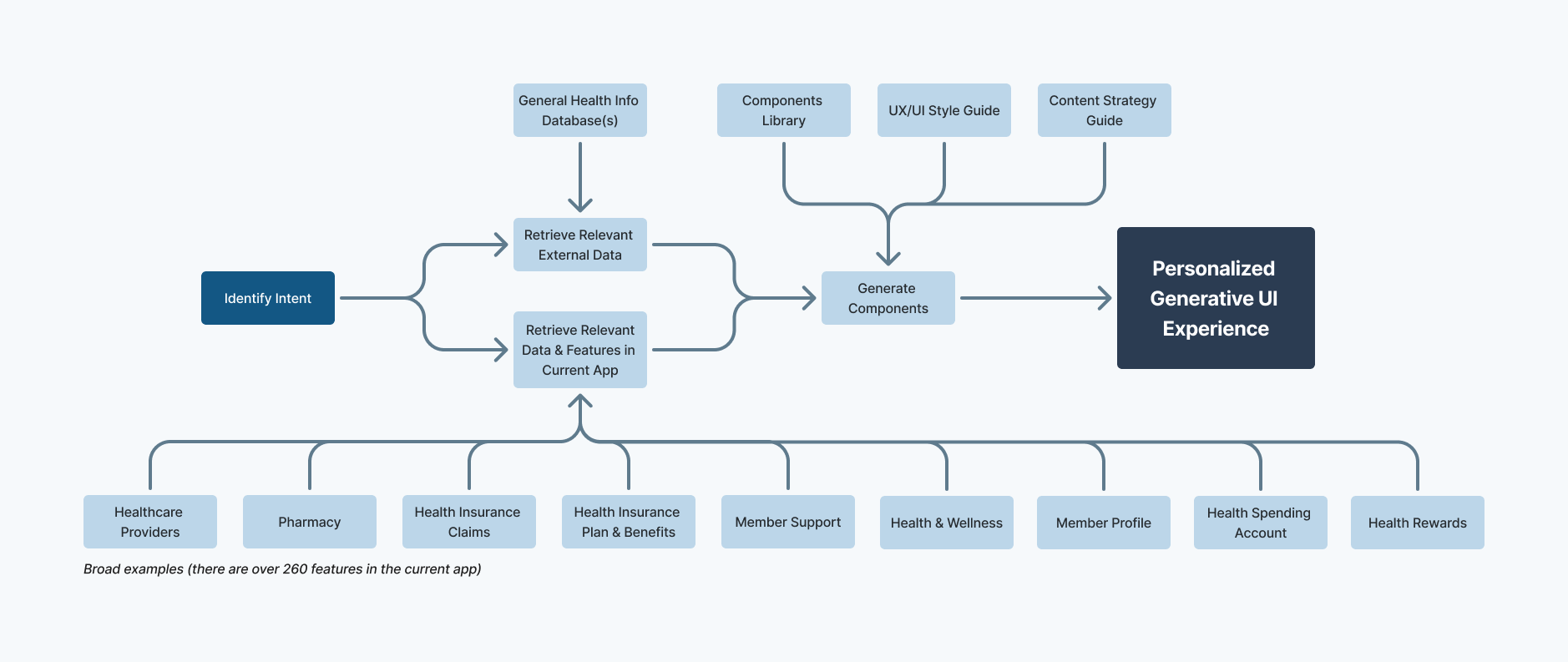
The system identifies the member’s intent, retrieves relevant health information from integrated vendors and data from the existing app, and combines it with established UI components, design guidelines, and content strategy rules. Using these inputs, it dynamically generates a personalized Generative UI experience tailored to the member’s needs and context.
Use Case: Kathy’s Hip Replacement Consultation and Follow-Up
This use case demonstrates how a virtual assistant can support members throughout their surgical journey, from preparation to recovery. Before a consultation, the assistant provides a personalized preparation guide. When the member arrives for her appointment, a timely push notification offers the option to record the visit, allowing the assistant to capture key information and check off questions as they’re answered. Afterward, the visit summary and transcript are added to the same conversation, creating a continuous resource. Following surgery, the assistant generates a personalized recovery guide to help the member navigate next steps and ongoing care.
Current State
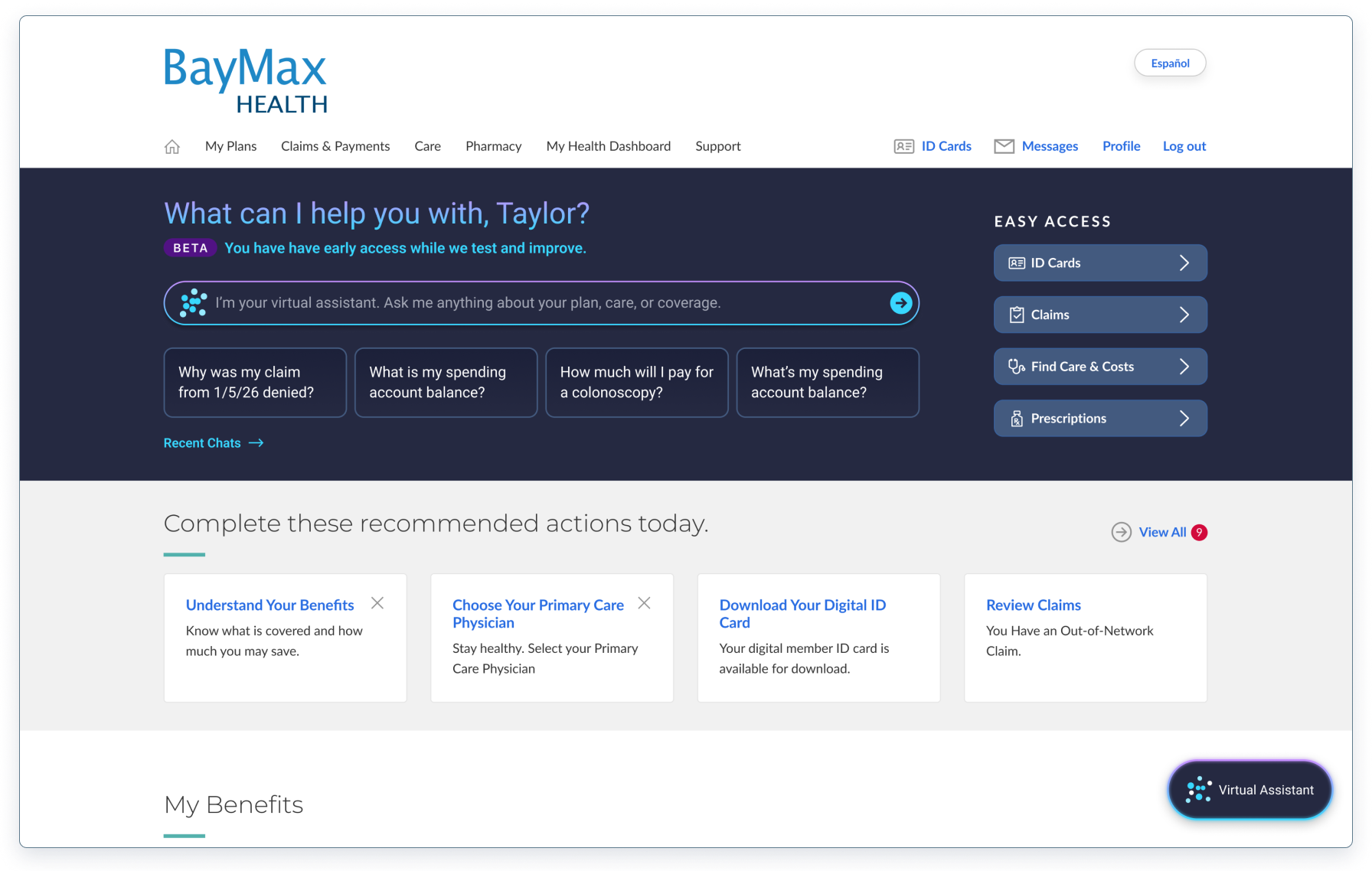
Inspired by the original concept, the virtual assistant continues to evolve across the website and app. A prominent assistant hero on the home page provides an entry point, while a floating action button makes the assistant accessible from internal pages. Informed by user feedback from Pilot 2, the experience was refined to avoid taking over the entire home screen, meeting users where they are rather than demanding their attention. The assistant delivers personalized responses, suggests relevant next steps based on a member’s needs, and offers contextual follow-up prompts while inviting open-ended questions. While not all elements of the original vision have made it into implementation, the experience continues to improve, with strong business support for future enhancements.